Amritam Das Assistant Professor · Control Systems Eindhoven University of Technology
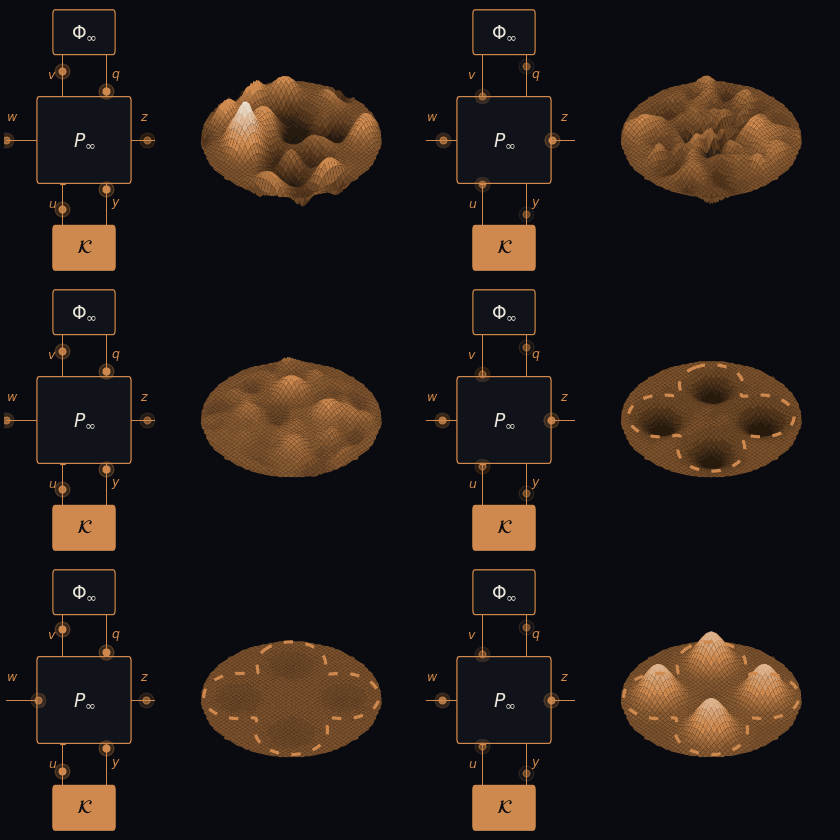
01 Control of PDEs &
Distributed Systems
PDE Control · Multi-Physics
  • Dual representations & H∞ control of PDEs IEEE TAC 2026
  • Frequency-Domain Bounds for Telegrapher's Eq. IEEE TCAS-I
  • RHYME-XT: Neural Operator for Spatiotemporal Control arXiv 2026
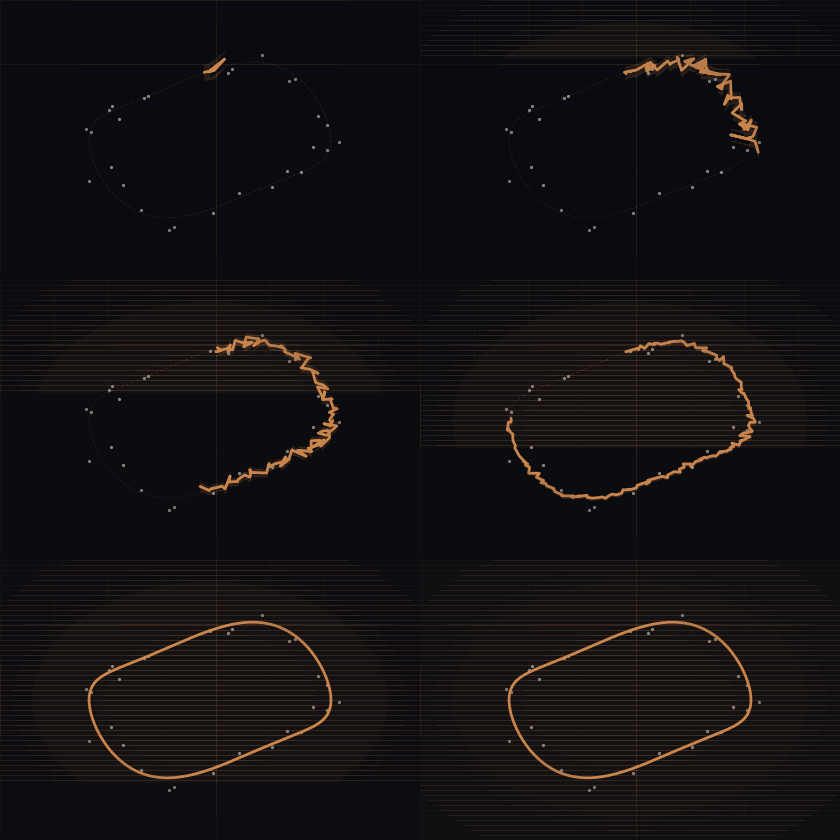
02 Physics-Informed
Learning
Certifiable · Interpretable Models
  • Learning Surrogate LPV State-Space Models arXiv 2026
  • On-the-fly Surrogation for Nonlinear Dynamics CDC 2025
  • Bayesian Grid Allocation for LPV Control arXiv 2026
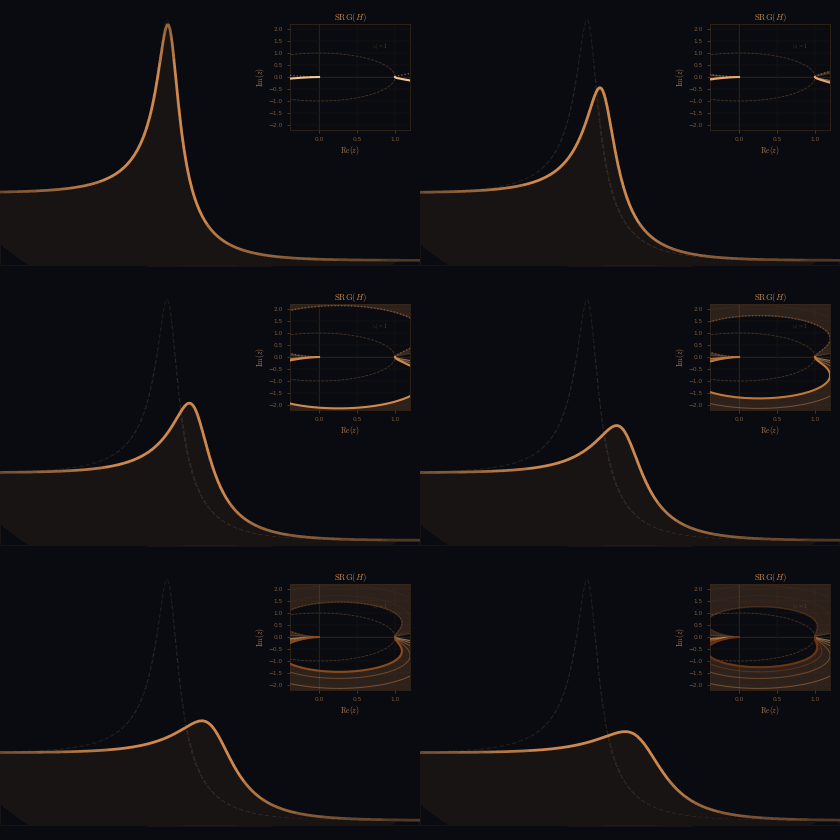
03 Nonlinear &
Passivity-Based Control
Scaled Relative Graphs · Performance Shaping
  • Amplitude-Dependent Bode Diagrams via SRGs arXiv 2026
  • Nonlinear Bandwidth & Bode via SRGs CDC 2025
  • Automated LPV Modeling of Nonlinear Systems IFAC 2025
04 Fusion · Neuro-Eng
· High-Tech Systems
Fusion · Brain · Mobility · Lithography
  • Control for Societal-Scale Challenges Roadmap 2023
  • Fault Diagnosis for High-Tech Manufacturing Canon Production Printing
  • Distributed Estimation for Neuro-Engineering EU Horizon
Scroll
Amritam Das
About

Control where
physics meets
data.

I am an Assistant Professor of Spatio-Temporal Control Systems in the Control Systems group at TU Eindhoven. My research develops computational methods that combine the structure of physical laws with the flexibility of data-driven learning — to design control systems that are certifiable, interpretable, and performant in the real world.

I work on dynamical systems whose behaviour emerges from distributed networks of interacting components, governed by partial integro-differential equations under sensing constraints. Before joining TU/e, I was a postdoctoral fellow at KTH Stockholm and a research associate at the University of Cambridge (Sidney Sussex College).

2023Joined TU/e
PDEsCore Method
4Research Themes
3Continents Trained
Manifesto

The world is not
a black box.

Modern data-driven methods are remarkable approximators. Yet the systems we most want to control — fusion reactors, lithography stages, the human brain, large-scale energy grids — are governed by partial differential equations, by conservation laws, by symmetries that data alone cannot reveal. Treating them as black boxes is not just inefficient. For safety-critical applications, it is unacceptable.

"How can we combine known invariants with real-world data to guarantee the best performance of physical systems?"

My answer is to build a control science that respects the continuum nature of distributed physical systems. Algorithms that exploit passivity, symmetry, and dispersion relations as structural priors rather than rediscovering them from scratch. Methods that come with quantifiable guarantees on stability, performance, and uncertainty.

This is the agenda of spatio-temporal control: algorithms that are discretization-independent, that scale with the physics rather than fight against it, and that meet the demands of high-tech systems where failure is not an option. My research advances this vision through four interlocking themes:

01
Research Theme

Control of PDEs &
Distributed Systems

Multi-physics processes — from plasma confinement to wafer-stage thermal dynamics — are inherently distributed in space and time. We design control strategies that operate directly on the partial-differential structure of these systems, providing performance guarantees that survive any discretization.

IEEE TAC 2026

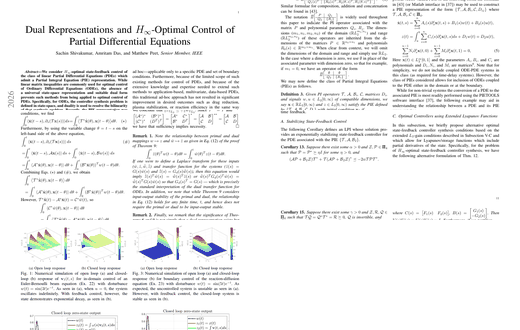
Dual Representations and H∞-Optimal Control of Partial Differential Equations

Shivakumar, Das, Peet

Read paper →
IEEE TCAS-I 2026

Frequency-Domain Bounds for the Multiconductor Telegrapher's Equation

Selvaratnam, Moreschini, Das, Parisini, Sandberg

Read paper →
arXiv 2026

RHYME-XT: A Neural Operator for Spatiotemporal Control Systems

Ruiter, Aguiar, Rap, Johansson, Das

Read paper →
02
Research Theme

Physics-Informed
Learning

Real-world systems leave fingerprints in their data — but those fingerprints are far more informative when read through the lens of physics. We develop surrogate models that fuse continuum-mechanical structure with data-driven flexibility, equipped with rigorous uncertainty quantification.

arXiv 2026

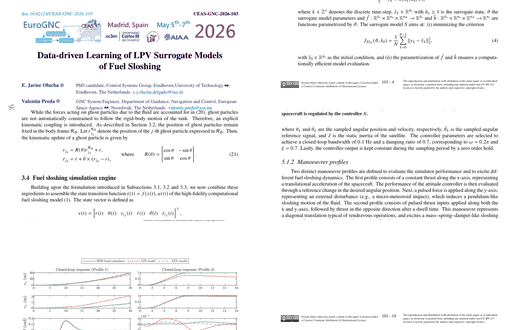
Learning Surrogate LPV State-Space Models with Uncertainty Quantification

Olucha, Preda, Das, Tóth

Read paper →
IEEE CDC 2025

On-the-fly Surrogation for Complex Nonlinear Dynamics

Olucha, Singh, Das, Tóth

Read paper →
arXiv 2026

Bayesian Optimization Based Grid Point Allocation for LPV and Robust Control

Olucha, Sadeghzadeh, Das, Tóth

Read paper →
03
Research Theme

Nonlinear &
Passivity-Based Control

Linear intuition fails the moment a system enters its nonlinear regime — and most interesting systems live there. We extend classical frequency-domain tools (Bode, Nyquist, bandwidth) to nonlinear settings using scaled relative graphs, enabling design that is both rigorous and practical.

arXiv 2026

Amplitude-Dependent Bode Diagrams via Scaled Relative Graphs

Krebbekx, Tóth, Das, Chaffey

Read paper →
IEEE CDC 2025

Nonlinear Bandwidth and Bode Diagrams based on Scaled Relative Graphs

Krebbekx, Tóth, Das

Read paper →
IFAC 2025

Automated Linear Parameter-Varying Modeling of Nonlinear Systems

Olucha, Koelewijn, Das, Tóth

Read paper →
04
Research Theme

Fusion · Neuro-Eng
· High-Tech Systems

The methods only matter if they reach the real world. Our lab translates theory into deployments across nuclear fusion plasma control, photolithography stages, brain–machine interfaces, and large-scale mobility — each a proving ground for spatio-temporal control science.

Roadmap 2023

Control for Societal-Scale Challenges: Road Map 2030

IEEE CSS Workshop · co-organizer

Read paper →
Industry · Canon

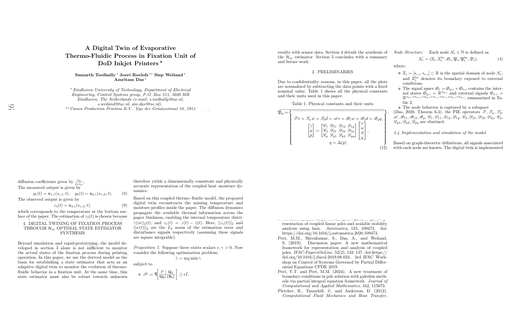
Fault Diagnosis & Mitigation for High-Tech Manufacturing

Joint research with Canon Production Printing

Project page →
EU · ESA

Distributed Estimation for Aerospace and Neuroengineering

EU Horizon & European Space Agency consortia

Project page →
Partnerships & Collaborations

Industry &
Public Research

Long-term collaborations bridging fundamental control theory with the demands of real engineering systems.

TU/e
Home Institution
Eindhoven University of Technology

Control Systems group, Department of Electrical Engineering. Faculty position since February 2023, building the spatio-temporal control research line.

Canon
High-Tech Industry
Canon Production Printing

Industrial collaboration on fault diagnosis, model reduction, and distributed control for next-generation production printing systems.

ESA
Aerospace Research
European Space Agency

Funded research on robust LPV modelling and control for aerospace systems — with uncertainty quantification across the operating envelope.

KTH
Academic Network
KTH Royal Institute of Technology

Continuing collaboration with Decision & Control Systems on networked control, distributed estimation, and societal-scale challenges in control engineering.

Recognition & Trajectory

Career Path
& Honours

2023–
Assistant Professor — Spatio-Temporal Control Systems
Control Systems group, Department of Electrical Engineering, TU Eindhoven
TU/e
2021–22
Postdoctoral Scholar — Decision & Control Systems
KTH Royal Institute of Technology, Stockholm · networked & distributed control
KTH
2020–21
Research Associate — Control Group
University of Cambridge · Research Affiliate, Sidney Sussex College
Cambridge
2020
PhD in Systems & Control
TU Eindhoven · thesis on model reduction and control of distributed parameter systems
PhD
2022
Local Organizer — IEEE CSS Workshop
"Control for Societal-Scale Challenges" · Stockholm · co-authored Roadmap 2030
IEEE CSS
2014
Gold Medal — B.Tech Mechatronics Engineering
Top of class · India · followed by MSc Systems & Control (2016)
Gold
Selected Recent Work

Recent
Publications

View full list on Google Scholar →
Updates

News

2026

Two new IEEE Transactions papers — on dual representations for H∞ control of PDEs (TAC) and frequency-domain bounds for multiconductor telegrapher's equations (TCAS-I).

2026

RHYME-XT released — a neural operator architecture for spatiotemporal control systems, joint with KTH (Johansson group).

Dec 2025

Three papers at IEEE CDC 2025 on scaled relative graphs, on-the-fly surrogation, and nonlinear bandwidth analysis.

2025

New ESA-funded project on robust LPV control for aerospace launch and re-entry vehicles.

2024

Joined the Control Systems group at TU/e as Assistant Professor of Spatio-Temporal Control — now building a lab focused on PDE control and physics-informed learning.

May 2023

Roadmap published — "Control for Societal-Scale Challenges: Road Map 2030" appears as community-wide guidance from the IEEE CSS workshop.

2023

Industrial partnership formalised with Canon Production Printing on fault diagnosis and distributed estimation for high-tech manufacturing.

2022

Co-organised the IEEE CSS Workshop on Control for Societal-Scale Challenges in Stockholm.